Can You Sue an Insurance Company for a Denied Claim?
Yes, you can sue an insurance provider or insurance company. If they deny your claim, delay processing, or offer inadequate settlements, legal action may be an option. This article explores the legal grounds for asking, “Can you sue an insurance company?” along with the steps to take before filing a lawsuit and the potential challenges involved.
For a free legal consultation, call (832) 323-3000
For a free legal consultation, call (832) 323-3000
Key Takeaways
✓ Policyholders can sue insurance companies for denied claims, unreasonable delays, or inadequate settlements, especially when they act in bad faith.
✓ Before filing a lawsuit, it’s essential to review your insurance policy, gather evidence, and attempt negotiation with the insurer to strengthen your case.
✓ Hiring an experienced attorney can significantly enhance your chances of success by providing legal expertise, negotiation skills, and guidance through complex procedures.
Legal Grounds for Suing an Insurance Company
When insurance companies act in bad faith, policyholders have the right to take legal action—and it’s worth understanding your rights when suing an insurer before you begin. Holding an insurance company accountable is crucial when they fail to fulfill its obligations. The legal grounds for suing an insurance company often include unreasonable claim denials, delays, or inadequate settlements. Here’s a closer look at each scenario.
Denied Claims
Imagine paying premiums for years, only to have your valid claim denied. This is a classic example of bad faith in insurance. Insurance companies sometimes deny claims without valid reasons, failing to investigate thoroughly or providing false reasons for the denial. In such cases, policyholders may have grounds for legal action. Maintaining detailed records of all interactions with the insurance company is essential—these records can serve as crucial evidence if legal action is pursued, demonstrating that the denial was unjustified.
Occasionally, insurers might misinterpret policy terms or incorrectly apply exclusions, thereby denying valid claims. This tactic is often employed to avoid payouts. Consulting a lawyer familiar with insurance disputes is advisable if you encounter this situation. A lawyer can help navigate the complexities of the case and secure the compensation you deserve.
Delayed Claims Processing
Unreasonable delays in processing claims can be just as frustrating as outright denials. These delays can lead to mounting bills and financial stress for policyholders. When insurance companies fail to adhere to required claim processing timelines, policyholders can face significant financial strain. Such delays can sometimes be a tactic to prompt policyholders into providing additional documentation. Legal action can be initiated if these delays are unjustifiable.
When facing such delays, meticulously record all communications and document any resulting financial hardships. This evidence can bolster your case if legal action against the insurance company becomes necessary.
Inadequate Settlements
Receiving a settlement offer far below the actual damages incurred can be infuriating. Large insurance companies often propose lowball settlements to save costs, which can leave policyholders at a significant financial disadvantage. This form of exploitation can lead to legal action as policyholders seek fair compensation.
An attorney can significantly enhance your chances of securing a favorable settle ment. Experienced lawyers can negotiate better offers on your behalf, ensuring your claim’s true value is accurately reflected.

Real-World Example
A well-known example involves State Farm, which faced a class-action lawsuit in California after allegations that it wrongfully denied or underpaid homeowners’ insurance claims following wildfires. The case drew national attention to bad-faith insurance practices and showed how policyholders can hold insurers accountable when insurers fail to meet their obligations.
Case Law Reference
One of the landmark cases in insurance bad faith is Gruenberg v. Aetna Insurance Co., 9 Cal.3d 566 (1973), where the California Supreme Court held that insurers owe their policyholders a duty of good faith and fair dealing. Breach of this duty can result in tort liability, reinforcing a policyholder’s right to sue.
Interesting Statistic
According to the American Association for Justice, over 50% of consumers who challenge denied insurance claims without legal help are unsuccessful—yet policyholders represented by attorneys are three times more likely to receive full or partial compensation.
Click to contact our property damage lawyers today
Complete a Free Case Evaluation form now
Steps to Take Before Filing a Lawsuit
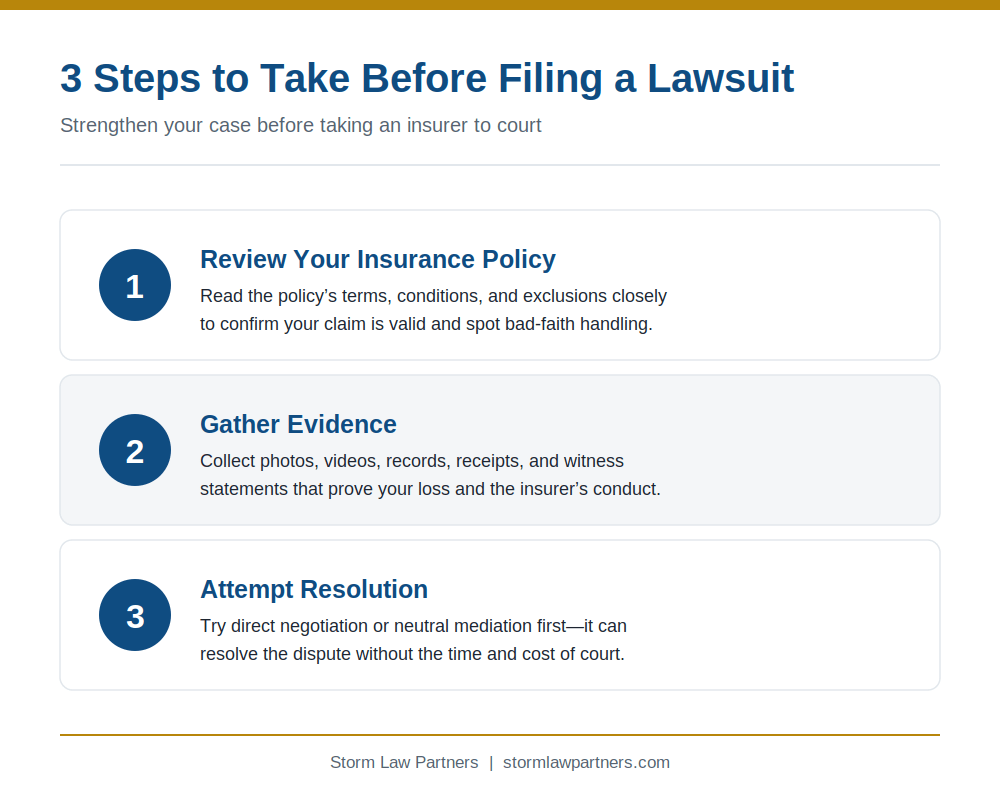
Before initiating legal proceedings, take essential steps to strengthen your case: reviewing your insurance policy, gathering evidence, and attempting resolution through negotiation or mediation. You should also confirm you’re still within the statute of limitations for insurance claims in your state, since missing that deadline can bar your case entirely. Here’s a breakdown of each step in detail.
Review Your Insurance Policy
The first critical step is understanding your insurance policy. Unclear or misleading explanations about policy coverage from insurers can be grounds for a lawsuit. Thoroughly reviewing your policy helps you understand the terms and conditions, verifying whether your claim is valid and whether the insurance company is acting in bad faith.
Gather Evidence
Assembling evidence is essential for building a strong case. Include photos, videos, medical records, receipts, and witness statements that support your claim. Detailed documentation can go a long way toward proving that your insurance company acted unfairly or in bad faith.
Attempt Resolution
Direct negotiation with your insurer can sometimes resolve disputes without litigation, and mediation with a neutral third party can also be beneficial. These steps can save time and money compared to court proceedings, making them worth considering before filing a lawsuit.
The Legal Process of Suing an Insurance Company
Knowing the legal process is crucial for anyone considering suing an insurance company. This process involves several steps, including filing a complaint, the discovery phase, and court proceedings. Each step requires careful preparation and adherence to legal protocols to ensure a successful outcome.
Filing a Complaint
To initiate a lawsuit, you must formally file a complaint that outlines your claims against the insurance company. This complaint must be detailed, specifying the reasons for the lawsuit and the compensation you seek. Properly serving the insurance company with these documents officially notifies them of the lawsuit and sets the stage for further legal action.
It is essential to ensure that your complaint is valid and recognized by the court. This requires adherence to specific legal protocols and the proper filing of the necessary paperwork. An attorney can navigate these complexities and help avoid procedural missteps that could jeopardize your case.
Discovery Phase
The discovery phase is a critical part of the legal process where both parties gather evidence to support their cases. During this phase, documents are exchanged, and depositions are taken to build your case. Depositions involve formal sessions where witnesses, including yourself, provide sworn testimony regarding the case.
This phase is vital for uncovering all relevant information and ensuring both parties have a fair chance to present their evidence. Effectively managing the discovery phase can significantly impact your lawsuit’s outcome.
Court Proceedings
Court proceedings are the final stage of the legal process. It is crucial to attend all hearings and follow the judge’s instructions. If representing yourself, study the rules of evidence and court procedures to effectively present your case.
Be prepared for questions from the insurance company’s attorney or representative. Thorough preparation and adherence to court rules can greatly influence your case’s outcome.
Potential Challenges and Risks
Suing an insurance company involves several challenges and risks. Legal complexities, financial costs, and time commitment are significant factors to consider. Recognizing these challenges can help you make an informed decision about pursuing legal action.
Legal Complexity
The legal process of suing an insurance company is complex and can be overwhelming for individuals without legal expertise. Knowing the rules of evidence and legal procedures is crucial, as mistakes can lead to severe penalties or case dismissal. Thorough preparation is key to effectively navigating these complexities.
Financial Costs
Legal action can be costly, with expenses extending beyond attorney fees to include court filing fees and expert witness charges. These costs can accumulate significantly, making it essential to consider the financial implications before pursuing a lawsuit.
Time Commitment
Representing yourself in legal matters requires a significant time commitment. Managing legal tasks, staying updated with case developments, and attending court hearings can consume substantial personal time and resources. This commitment can affect your personal life, so it’s important to weigh this factor before proceeding.
Click to contact our property damage lawyers today
Benefits of Legal Representation
Hiring an attorney offers significant advantages when suing an insurance company. Legal representation can enhance your chances of success, provide professional negotiation skills, and help navigate complex legal procedures. Here’s a detailed look at these benefits.
Additional Expert Insight
From a first-party attorney’s perspective, it’s worth emphasizing the growing legal trend of punitive damages in bad faith lawsuits. These damages aren’t just about reimbursement—they punish insurers and deter unethical behavior. When your insurer acts egregiously, courts may award compensation beyond your initial loss, a crucial factor in high-stakes claims.
Expertise and Experience
Legal representation is crucial when suing an insurance company, as it can significantly affect the claim’s outcome. An experienced insurance lawyer can influence the compensation amount recovered. Plaintiffs without attorneys may receive compensation far below what they deserve, and self-representation may result in lower settlements or judgments. A qualified attorney’s expertise can make a substantial difference, ensuring fair compensation and protecting your rights throughout the legal process.
Negotiation Skills
Having legal representation can lead to more favorable negotiation outcomes. Skilled attorneys often secure more advantageous settlements than individuals might achieve on their own. Their effective negotiation techniques can result in higher settlement offers, increasing your chances of receiving a fair and just settlement.
Navigating Legal Procedures
An attorney provides crucial assistance in navigating complex legal procedures, ensuring compliance with applicable state laws and regulations and offering professional representation during litigation. Guided by an attorney, you can avoid procedural missteps that could jeopardize your case, ensuring all necessary legal paperwork is properly handled and your interests are protected.
Common Examples of Bad Faith Practices
Bad faith insurance practices by insurance providers can include misrepresenting policy terms, unreasonably denying valid claims, and offering lowball settlements. Recognizing these common examples can help you identify when your insurer is acting dishonestly and when to take legal action.
Misrepresentation of Policy Terms
Insurance companies may act in bad faith by providing misleading information about policy terms, causing policyholders to mistakenly believe they have coverage for claims that are actually excluded. Misrepresentation happens when insurers fail to disclose crucial information, resulting in unjust claim denials. Insurers can also exploit ambiguous policy language, interpreting terms in their favor.
Unreasonable Denial of Valid Claims
Failure to honor applicable coverage can significantly justify bad faith lawsuits against insurance companies. Bad faith practices often involve unjustified denials of valid claims. Recognizing unfounded denials is crucial, empowering policyholders to pursue legal action against their insurance companies.
Lowball Settlement Offers
Lowball settlement offers are significantly lower than the claim’s actual value, affecting policyholders’ financial recovery. These offers don’t cover the full extent of damages or losses incurred, leading to frustration and distrust toward the insurer. Policyholders should be ready to negotiate if they receive a lowball offer, and consider legal action if the settlement doesn’t reflect the true value of their claim.
Summary
Navigating the complexities of suing an insurance company can be daunting, but understanding your legal rights and taking the right steps can make a significant difference. From reviewing your policy and gathering evidence to pursuing a resolution and understanding the legal process, each step is crucial to building a strong case.
By recognizing bad faith practices and the benefits of legal representation, you can confidently pursue justice and seek the compensation you deserve. Don’t let your insurance company take advantage of you—stand up for your rights and hold them accountable.
Frequently Asked Questions
What are the main legal grounds for suing an insurance company?
You can sue an insurance company for unreasonable claim denials, undue processing delays, or inadequate settlement offers—particularly where the insurer has acted in bad faith.
What should I do before filing a lawsuit against my insurance company?
Before filing a lawsuit, thoroughly review your policy, gather all relevant evidence, and try to resolve the issue through negotiation or mediation. Taking these steps can strengthen your case and potentially lead to a quicker resolution.
What does the discovery phase involve in a lawsuit against an insurance company?
The discovery phase involves gathering evidence, exchanging documents, and taking depositions, allowing both parties to build their cases. It is a critical stage that can significantly shape the outcome of the lawsuit.
What are the potential challenges of suing an insurance company?
Suing an insurance company can be challenging due to the legal complexities, financial costs, and the extensive time commitment involved. Preparing thoroughly and seeking professional advice helps you navigate these challenges effectively.
How can hiring an attorney benefit my case against an insurance company?
An attorney can improve your case by leveraging their expertise and experience to enhance negotiations and navigate complex legal procedures, increasing your chances of a successful outcome.
Call or text (832) 323-3000 or complete a Free Case Evaluation form